
Tech companies require immediate access to developers.
The challenge isn’t just finding talent—it’s finding the right talent within budget and timeline constraints.
Eastern Europe remains the top solution in 2026.
The region’s IT outsourcing market is led by Bulgaria and Poland, each offering distinct advantages depending on your business requirements.
Let’s explore the key differences between Bulgaria and Poland for IT outsourcing in 2026.
Market Size and Growth Trajectory
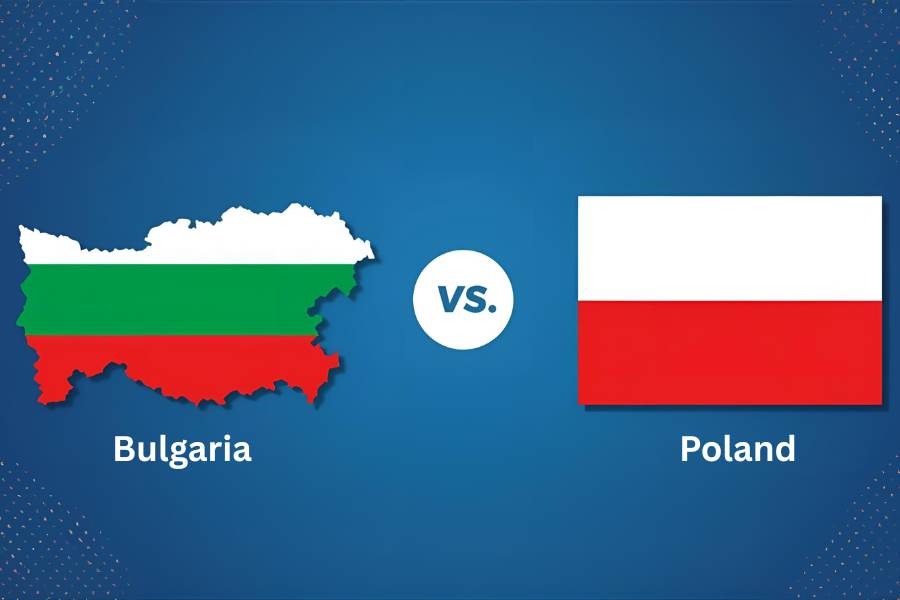
Poland’s IT Sector:Poland has over 500,000 IT professionals working across its major cities — Kraków, Warsaw, and Wrocław. The IT services market generates approximately $3.7 billion annually, with experts projecting continued growth at around 5.9% per year.
Bulgaria’s IT Sector:Bulgaria has 128,000+ IT professionals concentrated in Sofia, Plovdiv, and Varna. The IT services market generates $463 million annually, with outsourcing accounting for $180 million of that total. Bulgaria’s annual growth rate of 6.08% outpaces Poland’s. The ICT sector achieved 300% revenue growth over seven years, bringing total revenue to €2.5 billion. Sofia maintains its position as one of Europe’s fastest-growing technology hubs.
Salary Comparison: Bulgaria vs Poland 2026
See also: backend developer salaries in Bulgaria
80-Person Team Cost Analysis:
-
Poland: €3.7–4.6M annually
-
Bulgaria: €2.7–3.8M annually
-
Annual savings: €1M+
Bulgaria maintains a flat 10% corporate and personal income tax — the lowest in the EU. Poland’s rates are higher with more complex administrative requirements.
Time-to-Hire: Speed to Market

Bulgaria Timeline:
-
Average time-to-hire: 21–34 days
-
First candidate shortlist: 3–7 business days
-
Complete process: 2–6 weeks
Poland Timeline:
-
Average time-to-hire: 36–77 days
-
Senior mobile developers: 45–60 days minimum
-
Extended timelines driven by intense market competition
For 15 mobile developer positions, Bulgaria completes hiring in under 5 weeks while Poland often takes 3–4 months — a difference of 6–8 weeks.
Real Project Example — 15 Developers:
Bulgaria:
-
Week 1: Briefing, market mapping
-
Weeks 2–3: First 5 candidate interviews
-
Weeks 4–5: Offers sent, negotiations
-
Weeks 6–8: Onboarding first batch
-
Month 3: All positions filled
Poland:
-
Weeks 1–2: Job posting, initial sourcing
-
Weeks 3–6: Screening, first interviews
-
Weeks 7–10: Multiple interview rounds
-
Weeks 11–14: Offer negotiations
-
Month 4–5: Team complete
Related: Our IT recruitment process and see also our headhunting services
Mobile Developer Specialization

Poland’s 500,000+ IT professionals include only 8–10% mobile specialists, making senior iOS/Android engineers with React Native or Flutter experience increasingly hard to find.
Bulgaria’s mobile specialization rate reaches 12–14% of its developer pool. Sofia and Plovdiv host active mobile development communities, with Uber, VMware, and SAP all operating local offices.
Flutter demand grew 35% in 2025–2026 as cross-platform development has become standard practice. Flutter enables a single codebase to run across Android, iOS, web, and desktop — accelerating launch timelines while keeping costs manageable.
Bulgaria’s higher concentration of mobile specialists makes it the stronger choice for React Native and Flutter projects requiring fast delivery.
Related: 50+ Hiring Statistics Bulgaria: Key Insights and Trends
Education Systems and Technical Training
Poland’s prestigious technical universities produce thousands of IT and engineering graduates annually and attract active recruitment from Google, IBM, and Amazon.
Bulgaria embeds practical coding skills into high school curricula. Private academies Telerik and SoftUni operate fast-track programs that bring developers into the workforce within months. Bulgaria produces 6,000 new IT graduates yearly, with 15% annual market growth enabling team expansion of 30–50% without supply constraints.
Retention and Turnover
Bulgarian teams sustain annual retention rates above industry benchmarks (12–15% turnover), driven by concentrated market structure and strong corporate cultures that encourage long-term employment.
Poland’s developer workforce shows higher departure rates as aggressive poaching in a competitive market drives frequent job switches, especially at the senior level.
Work Culture and Communication Style
Both nations demonstrate strong English proficiency.
-
Polish teams favour formal communication with complete documentation and structured Agile methods — full Jira boards, daily standups, and standardised delivery processes. Ideal for large organisations requiring predictable operations.
-
Bulgarian teams prefer direct, informal communication that produces faster decisions. They adapt quickly to changing requirements and combine Balkan flexibility with EU regulatory compliance — well-suited for startups and agile product teams.
Infrastructure and Operational Environment
Poland offers international-standard infrastructure — high-speed rail, modern airports, and reliable connectivity — well-suited for hybrid work models requiring regular in-person touchpoints.
Bulgaria delivers fibre internet at some of the lowest prices in Europe. Major cities have established co-working facilities, and Sofia sits within two hours of most major European cities by air. Bulgaria combines solid office infrastructure with strong remote work capability.
Both countries share the Central European time zone, enabling smooth collaboration with Scandinavian and Western European clients.
Global Outsourcing Context
The global IT outsourcing market is projected to exceed $600 billion by 2026, with the US generating the highest revenue and India holding approximately 17% of global software outsourcing share. Eastern Europe continues to grow its market presence as businesses increasingly prefer nearshoring over offshoring.
In 2026, organisations select partners based on value delivered — specialised knowledge, security capabilities, and strategic alignment — rather than cost alone.
Emerging Factors Influencing Outsourcing Strategies in 2026
Security and Data Privacy
Data security has moved to the top of outsourcing evaluation criteria. Partners must demonstrate encryption, access control, and compliance with GDPR and HIPAA. Certifications such as ISO/IEC 27001 and SOC 2 are now expected rather than optional.
Both Bulgaria and Poland are EU member states with full GDPR compliance. Bulgaria’s compact tech sector allows rapid security deployment across its vendor network. Poland’s larger market offers established providers with comprehensive compliance frameworks.
Cloud Computing and BYOD
Enterprise cloud adoption exceeds 97% in 2026, with public cloud spending projected to reach $1 trillion by 2027. Organisations outsource cloud infrastructure management to access specialist skills without full-time investment.
BYOD and CYOD policies require outsourcing partners to support Enterprise Mobility Management (EMM) — handling mobile device management, application control, and secure access for remote teams.
Bulgarian businesses demonstrate fast cloud adoption, supported by Sofia’s strong digital ecosystem. Poland’s cloud migration market delivers enterprise-grade solutions through methodical deployment.
AI, Automation, and Chatbot Development
AI-assisted development, ML model deployment, and intelligent automation are the fastest-growing outsourcing categories in 2026. Organisations need partners capable of building custom automation pipelines and conversational AI tools — not just delivering standard software.
DevOps is now a baseline expectation. CI/CD pipeline automation, Kubernetes, and Docker proficiency are standard requirements rather than differentiators.
The Bulgarian government established an AI research facility in Sofia to attract international investment and accelerate local AI talent development. Poland’s large developer pool brings strong capabilities in data analytics and enterprise AI deployment.
Strategic Partnerships Over Transactional Relationships
The most successful 2026 outsourcing relationships are partnerships, not vendor arrangements. Businesses want partners who understand their operations, communicate directly, and take accountability for outcomes.
-
Bulgarian providers offer direct CEO access, fast decision-making, and flexible scope adjustments — enabling new projects to launch within days of initial contact.
-
Polish vendors deliver enterprise partnerships through systematic documentation, formal governance, and structured Agile methodologies — reliable for large, long-running programmes.
Key Outsourcing Decision Drivers
Three factors drive 70% of outsourcing decisions: cost optimisation, specialist skill availability, and operational flexibility.
1. Cost OptimisationEastern Europe costs 30–60% less than the US or Western Europe. Hourly rates: Poland $42–58, Bulgaria $30–52. An 80-person mobile team saves €1M+ annually in Bulgaria versus Poland.
2. Specialist AvailabilityPoland’s 500,000+ IT professionals offer deep Java, AWS, and backend expertise. Bulgaria’s 128,000+ developers specialise in Flutter, React Native, and mobile — with a 12–14% mobile specialisation rate versus Poland’s 8–10%.
3. Operational FlexibilityBulgaria scales teams 30–50% with minimal overhead. Companies hire 15 people within 28 days. Poland’s larger market supports major programmes but involves longer administrative processing.
Decision Framework: Which Country to Choose
Choose Poland for:
-
Enterprise-scale projects requiring 100+ engineers
-
Deep Java, AWS, and backend infrastructure expertise
-
Structured delivery through established outsourcing providers
-
Mandatory formal Agile processes
-
Long-term engagements with predictable methodologies
Choose Bulgaria for:
-
Mobile-focused teams requiring Flutter and React Native specialists
-
Fast hiring timelines under 30 days
-
Startups and mid-size firms needing operational flexibility
-
Projects requiring 25–30% better ROI
-
Direct communication and quick adaptation
Making Your Decision
In 2026, companies are no longer simply buying cheap development hours. They are selecting business partners who bring domain expertise, take ownership, and adapt alongside them.
Bulgaria excels at agility. Its tightly connected tech community enables quick relationship-building — CEOs reachable on LinkedIn, meetings arranged within days, projects starting the following week. Fewer bureaucratic layers mean faster execution.
Poland excels at scale. Established frameworks support large teams, structured delivery, and long-term enterprise programmes — ideal for organisations managing 100+ engineers under direct oversight.
The smartest 2026 strategy often combines both: Poland’s depth for backend and enterprise infrastructure, Bulgaria’s speed and mobile expertise for product and app development.
Related:
6 Reasons to try IT outsourcing
Eastern European developer quality
Bulgarian IT developer salaries
Read: Popular IT Outsourcing Countries in 2024-2025
Frequently Asked Questions
Why does Bulgaria work better for mobile development teams?
Bulgaria's developer pool includes 12–14% mobile specialists compared to Poland's 8–10%. Senior developers become available in 21–34 days instead of 45–60 days, and teams achieve 12–15% higher annual retention rates. Sofia and Plovdiv attract top mobile talent because Uber, VMware, and SAP have all established operations there — giving companies immediate access to experienced Flutter and React Native developers. Flutter demand alone grew 35% in 2026, and Bulgaria is well-positioned to meet it.
What specific cost savings do Bulgarian development teams offer compared to Poland?
Senior mobile developers cost €3,100–4,300 monthly in Bulgaria versus €4,400–5,600 in Poland. For a team of 15 mobile developers, that translates to €180K–300K in annual savings. Bulgaria's flat 10% corporate and personal income tax — the lowest in the EU — delivers approximately 25% better ROI compared to Poland's more complex tax structure. For an 80-person team, total annual savings exceed €1M.
Does Bulgaria face talent shortage risks when scaling quickly?
Bulgaria's IT market is growing at 15% annually, with 6,000 new IT graduates entering the workforce each year. Sofia and Plovdiv can comfortably support business expansion of 30–50% without running into supply constraints. Stock options and flexible remote work arrangements contribute to strong retention, avoiding the high turnover rates seen in Poland's more competitive market. Bulgaria is home to over 10,000 ICT companies, with 70% of output directed toward export — a sign of a mature, internationally integrated tech sector.
How does political stability compare between Bulgaria and Poland?
Poland maintains stronger overall political stability. Bulgaria holds elections more frequently and government leadership changes regularly. However, Bulgaria's tech sector has proven resilient and operates largely independently from political shifts. The EU-mandated 10% flat corporate tax rate — the lowest in the bloc — remains unchanged regardless of which government is in power, preserving the business-friendly environment that international companies rely on.
What infrastructure advantages does each country offer?
Poland offers world-class infrastructure — high-speed rail connecting major cities, multiple international airports, and reliable enterprise-grade connectivity. It is particularly well-suited for hybrid work models that require regular in-person collaboration. Bulgaria offers some of Europe's fastest and most affordable fibre internet, well-developed co-working spaces in major cities, and two-hour flight access to most European capitals. Sofia combines solid office infrastructure with strong remote work capability, making it a practical base for distributed European teams.
Sources:
About the Author: Petia Topalova